Guide · Governance, policy and return on investment
How many UK businesses use AI, and how deeply?
About a third (35%) of UK businesses with 10 or more employees used AI in June 2026, up from about 12% in late 2023, according to the Office for National Statistics. Use is wide but shallow: only 10% of those businesses said they use it extensively, and 11% said more than half their workforce had AI training.
By Andrew Ward, Founder of ScorchsoftChecked 10 minute read
In short
- Most businesses that use AI use it lightly: on average about 1.6 kinds of AI technology each, up from about 1.4.
- People are ahead of their employers. Over half of employees (55%) say they use AI for work or education, but only 13% of UK employees have had any training in using it at work.
- If you haven’t started, you aren’t late. About two-thirds of businesses with 10 or more staff didn’t report using any AI in June 2026.
- The step few organisations have taken is from personal use to shared, trained practice. That step needs time and training more than budget.
- Ask your own organisation the questions the ONS asks: do we use AI, how much, how many of our people, and how many are trained?
Written for: Owners, managers and anyone in a UK organisation asking how their use of AI compares with everyone else’s.
How many UK businesses use AI?
In June 2026, about 35% of UK businesses with 10 or more employees said they used at least one AI technology, up from about 12% in September 2023. Larger businesses and digital industries use it most.
The figures come from the Office for National Statistics’ Business Insights and Conditions Survey (BICS), wave 159, run from 5 to 28 June 2026, with 38,637 businesses responding. The ONS published them on 20 July 2026 in Artificial intelligence in UK businesses: 2023 to 2026 (opens in a new tab). Use rises with size, and varies a lot between industries:
| Group | Use AI |
|---|---|
| All businesses with 10 or more employees | About 35% |
| Businesses with 0 to 9 employees | 28% |
| Businesses with 250 or more employees | 49% |
| Information and communication | 58% |
| Construction | 13% |
The kinds of AI most often reported, by businesses with 10 or more employees, were large language models, the kind behind chat assistants (18%), and tools that create images or other visual content (16%). The most common reason given for using AI was improving operations.
What the survey covers
BICS covers most of the private sector, but not agriculture, energy, finance and insurance, public administration and defence, or public education and health. Answers are what businesses report about themselves, and the ONS calls these “official statistics in development”. Treat the figures as a good guide to the shape of things, not a precise count.
How deeply are UK businesses using AI?
Not very deeply, yet. Of the businesses with 10 or more employees that use AI, only 10% said they use it extensively, and the average business using AI uses about 1.6 kinds of AI technology, up only modestly from about 1.4.
The ONS added new questions in June 2026 on how much businesses use AI and how many of their people use it. Its answers, for businesses with 10 or more employees:
- 10% of businesses that use AI said they use it extensively. Small businesses were more likely to say so than large ones: 17% of those with 0 to 9 employees, against 9% of those with 250 or more.
- 15% of businesses said that more than half of their employees use AI as part of their daily work.
- 11% of businesses said that more than half of their workforce had received AI-related training.
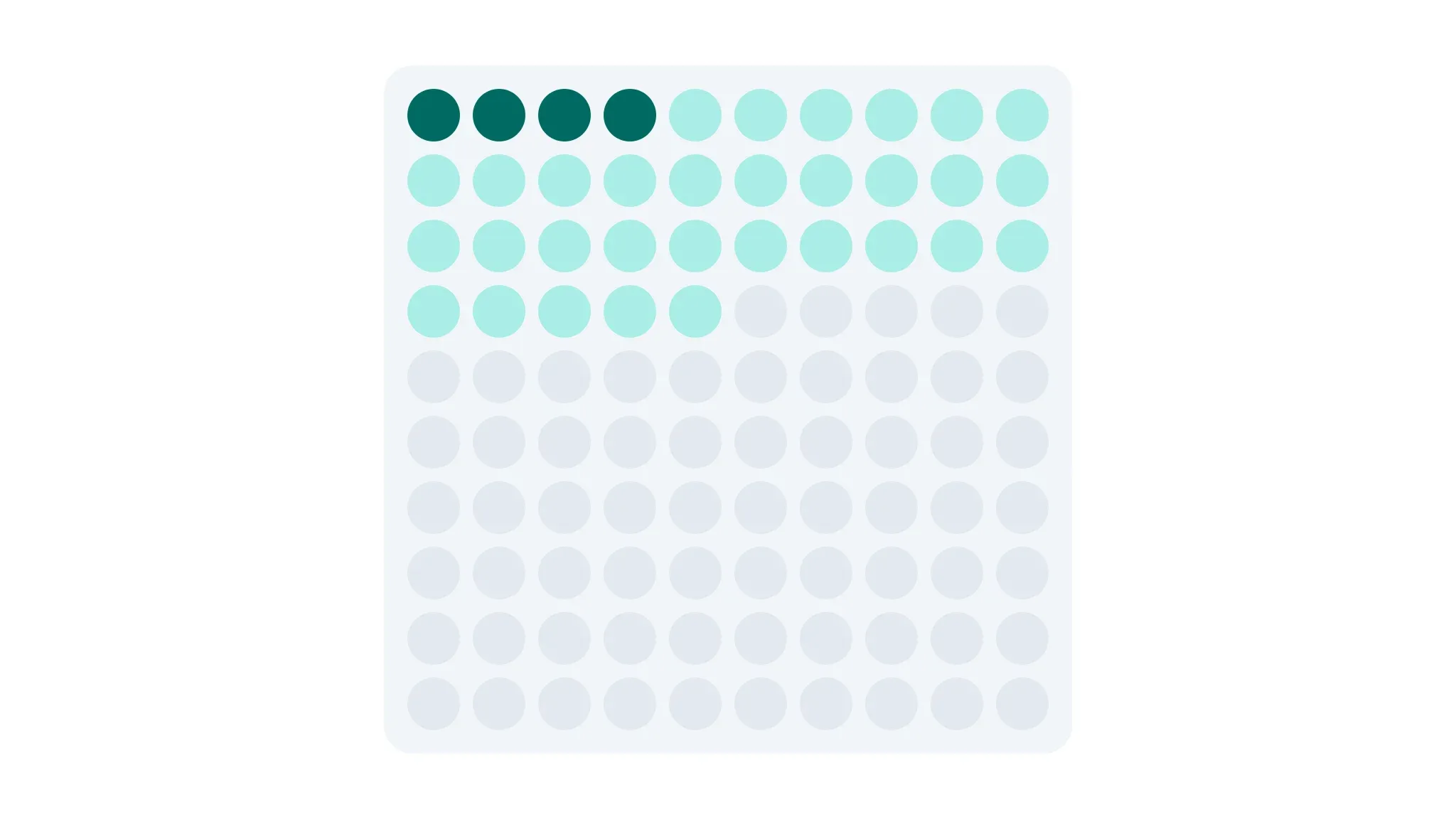
Put the first figure in proportion: 10% of the 35% who use AI is about 3 or 4 businesses in every 100. The ONS reads the slow rise in the number of technologies each business uses as a sign that AI has had relatively limited transforming effect so far. It also says the new questions give early indications only, and that larger businesses were more likely to be unsure how much they use AI.
Wide, but shallow
Picture 100 businesses with 10 or more staff. About 35 use some AI. Of those, about 3 or 4 use it extensively. The other 65 didn’t report any. Most of the movement still to come is in depth, not in who has tried it.
Why do more people use AI than businesses report?
Because much of it is personal. Over half of employees say they use AI for work or education, more than the share of businesses that report using it. Many people use their own tools, and few have been trained.
In the same ONS article, 55% of employed and self-employed people in Great Britain said they use AI for work or education (Opinions and Lifestyle Survey, 6 May to 28 June 2026). The two surveys ask different people different questions, so the figures aren’t a direct comparison, and the ONS notes that people’s answers may include informal use outside a business’s own activities. But the direction is clear: people are often ahead of their organisations.
The CIPD’s Good Work Index 2026, a YouGov survey of 5,074 UK employees from December 2025 to February 2026, points the same way. Only 13% of UK employees said they had received any training in using AI in their current job, and about two in three of those who use AI at work at least monthly had had none. Use without an agreed route is shadow AI: usually people trying to do a good job, not breaking rules on purpose. Our shadow AI guide covers why it happens and how to bring it into the open without blame.
What stops businesses using AI more?
Businesses most often name difficulty finding a use for it, cost and a lack of expertise. In June 2026, 41% of businesses with 10 or more employees reported no barriers at all in the previous three months.
The ONS’s earlier analysis of 2023 data, published in March 2025, found the most common reasons for not adopting AI, or delaying it, were difficulty identifying uses for the business, cost, and a lack of expertise. In June 2026, cost held back between about 7% and 14% of businesses, depending on size, and around 18% of businesses with 100 to 249 employees said a lack of expertise had delayed them.
Training is the most common response. Training existing staff was the most common way of bringing in AI skills in every size band, reported by around 40% of medium and large businesses. Among businesses that named a lack of expertise as a barrier, around 62% were training or retraining staff, against around 26% of those reporting no barriers. About 10% of businesses reported automating or replacing roles, with little difference by size.
On jobs, around half of businesses said AI had had no effect on their headcount, and just under 7% of medium-sized businesses reported a fall. The ONS calls these early indications. Our guide Will AI take my job? sets out the wider evidence.
Where does this leave most organisations on the AI Stairway™ to Success?
The ONS doesn’t measure our steps, so these figures can’t place anyone. But the pattern they describe, AI tried widely and used deeply by few, matches the lower steps: approved tools in some places, and know-how that is real but personal.
The AI Stairway™ to Success is Scorchsoft’s own seven-step model of how AI becomes part of an organisation that uses it, from step 0, no formal AI adoption, to step 6, AI-first strategy. It isn’t an industry standard, and it hasn’t been independently validated. Read against it, the ONS questions line up roughly like this:
| What the ONS asked | What it suggests | Nearest step |
|---|---|---|
| Does the business use any AI? | About two-thirds of businesses with 10 or more staff didn’t report any, though many of their people may use it | Step 0, no formal AI adoption |
| How many kinds of AI does it use? | About 1.6 on average: usually one or two tools | Steps 1 and 2, approved access and informal professional use |
| Do more than half its people use AI daily, and are more than half trained? | 15% and 11% of businesses said yes | Step 3, shared best practice, where habits are taught and shared |
| Does it use AI extensively? | 10% of businesses that use AI said yes | Steps 4 and 5, reusable agents and embedded workflows |
The step the figures suggest is rarest is the one from personal use to shared practice: from “Hayley knows how” to “the team knows how”. It doesn’t need a large budget. It needs approved tools, rules people can follow, and practical training, so that what works is written down and shared, and what doesn’t is caught. Our AI maturity model guide explains each step, and how to place your organisation on evidence rather than intentions.
Gareth Bennett runs a 40-person accountancy practice. Asked the ONS’s questions, he would honestly answer that the practice uses one AI tool, that a handful of people use it daily, and that nobody has been trained. Hayley McAllister, his client services coordinator, uses AI every day on a personal account to draft client chasers. The practice counts in the 35%, but nowhere near the 10%. Gareth’s next step isn’t a new system: it’s an approved account, clear rules on client data, and training, so Hayley’s know-how becomes the team’s.
The AI Stairway™ to Success model © 2026 Scorchsoft Ltd. All rights reserved. The AI Stairway™ is a trade mark of Scorchsoft Ltd. Please don’t reproduce or adapt the model without permission.
What can you do with these figures this month?
Ask your own organisation the ONS’s four questions, find out who already uses AI and how, then choose one step: usually an approved tool, simple rules and training for the people already using it.
The ONS’s questions, for your own organisation
- Do we use any AI in the business, and which tools?
- Would we honestly say we use it extensively, or in a few places?
- Do more than half of our people use AI in their daily work?
- Have more than half of our people had any training in using it?
- Do we know which of our people use their own AI tools for work?
Step 1: Answer the questions on evidence (owner or manager, this week)
Answer from what you can show, not what you intend. If you can’t answer the fourth or fifth question, that’s your first finding, and it’s common.
Step 2: Ask, without blame (manager, next week)
Ask your team which AI tools they already use for work and what for, and say plainly that nobody is in trouble for past use. The shadow AI guide has a script for a no-blame “tell us what you’re using” week.
Step 3: Agree an approved route and simple rules (owner, within a month)
One approved tool on a business account, and tramlines for what data may go into it. The AI policy template shows what to write down.
Step 4: Train the people already using it first (manager, within a month)
They have habits worth keeping and some worth changing. Practical training turns personal know-how into shared practice. The AI literacy guide covers what good training includes.
The AI Stairway™ is our e-learning course for this step: ten modules, each under an hour, that teach safe, useful AI habits from a first prompt to shared team skills and workflows. Module 1, From Unsure to Useful, asks each learner to place two markers on the AI Stairway™ to Success, one for their organisation and one for their own practice, and the gap between them is usually where to start.
Questions people ask
What percentage of UK businesses use AI?
About 35% of UK businesses with 10 or more employees said they used at least one AI technology in June 2026, according to the ONS. For businesses with 0 to 9 employees the figure was 28%, and for those with 250 or more it was 49%.
Does “10% use AI extensively” mean 10% of all businesses?
No. It is 10% of the businesses with 10 or more employees that use AI. As a share of all businesses that size, it is about 3 or 4 in every 100.
Are we behind if we don’t use AI yet?
Not by these figures. About two-thirds of businesses with 10 or more staff didn’t report using any AI in June 2026, and very few use it deeply. Your people may already use it on their own accounts, though, so the useful question is how it is being used, not whether.
Is AI reducing jobs in UK businesses?
Not widely, so far. Around half of businesses told the ONS that AI had had no effect on their headcount, and just under 7% of medium-sized businesses reported a fall. The ONS calls these early indications.
Where do these figures come from?
From the ONS’s Business Insights and Conditions Survey, wave 159 (5 to 28 June 2026), published on 20 July 2026, and its Opinions and Lifestyle Survey for the 55% of employees. The training figures for employees are from the CIPD’s Good Work Index 2026.
Training for the whole team
The AI Stairway™ gives everyone the same careful habits, then helps your team agree its rules and test one AI idea properly. Everyone can start with the free introductory module.
AI training for teamsSources
Every figure on this page comes from one of these. Links open in a new tab.
- Artificial intelligence in UK businesses: 2023 to 2026 (opens in a new tab). Office for National Statistics, 20 July 2026.
- Business Insights and Conditions Survey (BICS) quality and methods information (opens in a new tab). Office for National Statistics, read 12 November 2026.
- Management practices and the adoption of technology and artificial intelligence in UK firms: 2023 (opens in a new tab). Office for National Statistics, 24 March 2025.
- CIPD Good Work Index 2026 (section 5, generative AI) (opens in a new tab). CIPD, July 2026.
Keep going
Related guides
- AI maturity models: what they are, and how to use one honestly
- Shadow AI: why staff use unapproved AI tools, and what to do about it
- What is AI literacy? What it looks like at work, and what EU Article 4 asks
- AI readiness assessment: a 12-question self-check for your organisation
- Will AI take my job? An honest answer, with the evidence